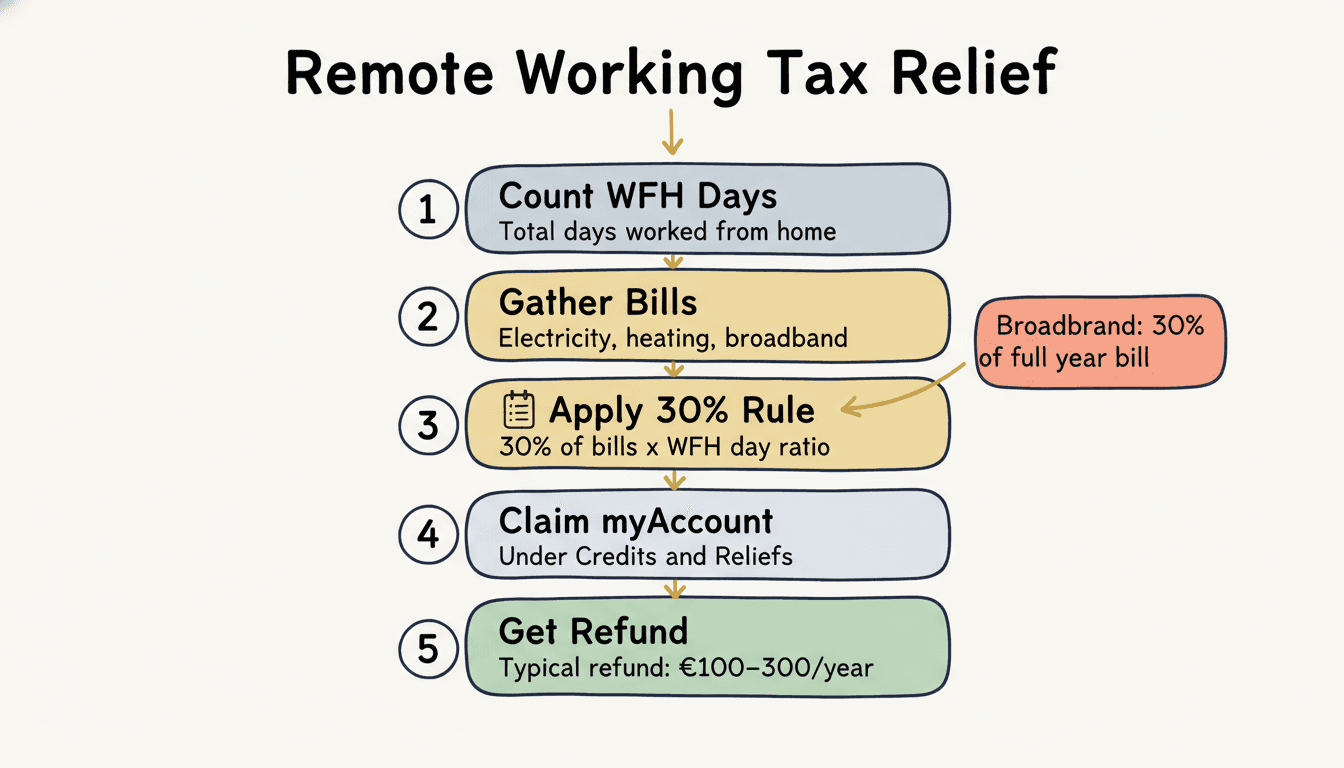
- Remote workers can claim 30% of electricity and heat costs, and 30% of broadband costs, as tax relief
- Relief is calculated on the number of days worked from home as a proportion of total working days
- You claim through Revenue myAccount — most workers get back €100–€300 per year depending on salary and days at home
Working from home has become a permanent fixture for hundreds of thousands of Irish workers since 2020. What many of those workers don't realise is that Revenue allows you to claim tax relief on the additional household costs you incur because you work from home. This isn't a new scheme — it was introduced in 2022 as a permanent measure — but it remains one of the most underclaimed reliefs available to PAYE workers.
What Costs Qualify for Remote Working Tax Relief?
Revenue allows tax relief on three categories of home office expense:
- Electricity — 30% of the electricity costs attributable to your working-from-home days
- Heat/Gas — 30% of heating costs attributable to your working-from-home days
- Broadband — 30% of the broadband costs attributable to your working-from-home days
Note that the relief is 30%, not 100%. Revenue recognises that these costs are partly personal and partly business-related, so 30% is treated as the work-related portion.
You cannot claim for mortgage interest, rent, home insurance, or general furniture. The relief is specifically for the utility and connectivity costs that increase when you're at home during the day.
How Is the Amount Calculated?
Revenue uses a formula based on the number of days you worked from home during the tax year, compared with your total working days.
Step 1: Gather your annual bills Add up your total electricity and heating bills for the year, and your total broadband bill.
Step 2: Work out your e-working days Count the number of days you worked from home during 2025. Your employer will confirm this figure. It does not include sick days, annual leave, or public holidays.
Step 3: Apply the formula
Qualifying expense = (e-working days ÷ total working days) × annual bill × 30%
Worked Example: Ciarán, PAYE worker, 120 days remote in 2025
| Expense | Annual Bill | × (120÷230 days) | × 30% | Relief Amount |
|---|---|---|---|---|
| Electricity | €1,800 | × 0.522 | × 30% | €281 |
| Gas/Heat | €900 | × 0.522 | × 30% | €141 |
| Broadband | €600 | × 0.522 | × 30% | €94 |
| Total qualifying relief | €516 |
At a marginal rate of 40%, Ciarán saves €206 in income tax. At the standard rate of 20%, the saving would be €103. Use the Irish Tax Estimator income tax calculator to check your own marginal rate.
Note: since 2022, broadband is treated exactly the same as electricity and heating — 30% of the cost, apportioned by your remote working days. (Under the older 2020–2021 rules broadband had a separate treatment, which is why some out-of-date guides describe it differently.)
What Records Do You Need?
You need to retain records to support your claim in case Revenue asks for evidence. Keep:
- Utility bills (electricity, gas) for the full year
- Broadband bills or a statement of annual spend
- Confirmation from your employer of the number of remote working days (a payslip note, HR email, or formal letter all work)
Revenue may request these in an audit. You don't submit them when filing your claim — only if asked.
How to Claim: Step by Step
Step 1: Sign in to Revenue myAccount Go to myaccount.revenue.ie and log in.
Step 2: Select "Review Your Tax" Choose the tax year you're claiming for (2025, or prior years going back to 2022).
Step 3: Enter e-Working Details Under the "Credits and Reliefs" section, select "Remote Working Relief" (also labelled "e-Working expenses"). You'll be asked to enter:
- Number of e-working days
- Total electricity costs for the year
- Total heating/gas costs for the year
- Total broadband costs for the year
Revenue calculates the qualifying relief amount automatically.
Step 4: Submit Revenue processes your return and any refund is paid directly to your bank account.
Revenue's remote working page has further guidance on the scheme.
Can You Claim for Previous Years?
Yes. You can claim remote working tax relief going back to 2022, within the standard four-year lookback period. If you worked from home in 2022, 2023, and 2024 and never claimed, you may be owed a cumulative refund across all three years.
What If Your Employer Already Pays You a Remote Working Allowance?
Some employers pay a daily remote working allowance to employees — Revenue allows employers to pay up to €3.20 per day tax-free to home workers. If your employer already pays this, you typically cannot also claim the remote working relief on the same costs. They are alternative methods of receiving the same benefit. Check with your employer or HR to confirm what, if anything, you receive.
PAYE vs Self-Employed Workers
PAYE workers claim through myAccount as described above. Self-employed workers claim e-working expenses on their Form 11. The same 30% rates apply.
Frequently Asked Questions
Can I claim remote working relief if I only work from home one or two days a week? Yes. The relief is pro-rated based on your actual e-working days. Even if you only worked from home 50 days in the year, you can still claim the proportional relief on those 50 days.
Do I need my employer to confirm the number of remote days? Revenue expects you to have documentary evidence of e-working days if audited. An email from HR, a remote-working agreement, or a letter from your employer all work. Some employers include e-working days on payslips.
Can I claim if I'm renting rather than owning my home? Yes. The remote working relief applies equally to renters and homeowners. You're claiming on utility bills you pay personally, not on the property itself.
My electricity bill is in a housemate's name. Can I still claim? You can only claim for costs you personally paid. If the bills are in someone else's name and they pay them, you wouldn't have a valid claim. If you contribute to bills via bank transfer and have records, that may be supportable — but this is a grey area and worth checking with Revenue or a tax advisor before claiming.
Is this the same as the €3.20 employer daily allowance? No. The €3.20 per day allowance is paid by your employer and is separate. The remote working relief is a personal tax claim you make directly with Revenue on utility costs you've personally incurred.
This article is for informational and estimation purposes only. It does not constitute professional tax advice. Tax rules can change. Always check Revenue.ie for the latest figures or consult a qualified tax advisor for your specific situation.
Written by a Chartered Accountant
All guides on Irish Tax Estimator are written and reviewed by a qualified Irish Chartered Accountant to ensure accuracy. This article is for general information only and does not constitute professional tax advice.
Share this guide