- Ireland charges 33% CGT on the profit from selling most assets — shares, investment property, land, and business assets
- You get an annual exemption of €1,270 — the first €1,270 of gains each year is tax-free
- Your principal private residence (the home you live in) is exempt from CGT when you sell it
Capital Gains Tax (CGT) applies when you sell an asset for more than you paid for it. In Ireland, the rate is 33% — one of the highest in the EU — and it catches many assets that people don't initially expect: shares, investment property, cryptocurrency, valuable artwork, and business goodwill. This guide covers how CGT works, what's exempt, and the key things to watch out for.
What Is Capital Gains Tax?
CGT is a tax on the profit (gain) you make when you dispose of an asset. "Dispose of" includes:
- Selling an asset
- Gifting an asset (CGT is based on the market value at the time of the gift)
- Swapping one asset for another
- Receiving compensation for an asset (e.g., insurance payout for damage)
The tax is calculated on the gain, not the full sale proceeds. You deduct the original cost (and certain other costs) from the sale price to get the taxable gain.
Rate: 33% in 2025. This rate has applied since Budget 2013 and was not changed in Budget 2025.
What Assets Does CGT Apply To?
The main categories of assets subject to CGT include:
- Shares and ETFs (Irish and foreign)
- Cryptocurrency (Bitcoin, Ethereum, etc.)
- Investment property (buy-to-let, holiday homes, land)
- Business assets (goodwill, machinery, IP)
- Foreign property
- Valuable personal property worth more than €2,540 (art, antiques, jewellery)
- Rights and interests in property
The €1,270 Annual Exemption
Every individual gets an annual CGT exemption of €1,270. This means the first €1,270 of your total net gains in any tax year is tax-free. Gains above this threshold are taxable at 33%.
The exemption cannot be carried forward — if you don't use it, you lose it. It also cannot be transferred between spouses (each spouse has their own €1,270 exemption, but they cannot pool them on a single asset sale).
Planning tip: If you have assets with built-in gains, consider selling just enough each year to crystallise up to €1,270 of gain and use your annual exemption, rather than triggering a large gain in one year.
What Is Exempt from CGT?
Several important categories are exempt from CGT:
Your principal private residence (PPR) The home you live in as your primary residence is completely exempt from CGT when you sell it, provided you've lived there throughout your ownership. Partial exemptions apply if you rented it out, used it for business purposes, or owned more land than is "required for reasonable enjoyment" (typically more than 0.4 hectares).
Irish government securities (Gilts) Profits from selling Irish government bonds are CGT-exempt.
Personal use assets below €2,540 Gains on disposing of personal property (furniture, cars, clothing) are exempt, and gains on any single item worth less than €2,540 at disposal are also exempt.
Life assurance policies Gains on standard life assurance policies are generally not subject to CGT (they may be subject to exit tax instead — a related but different regime).
Agricultural relief and retirement relief Qualifying farmers selling farm land and business owners selling qualifying businesses may be eligible for significant reliefs that reduce or eliminate CGT. These reliefs have complex conditions.
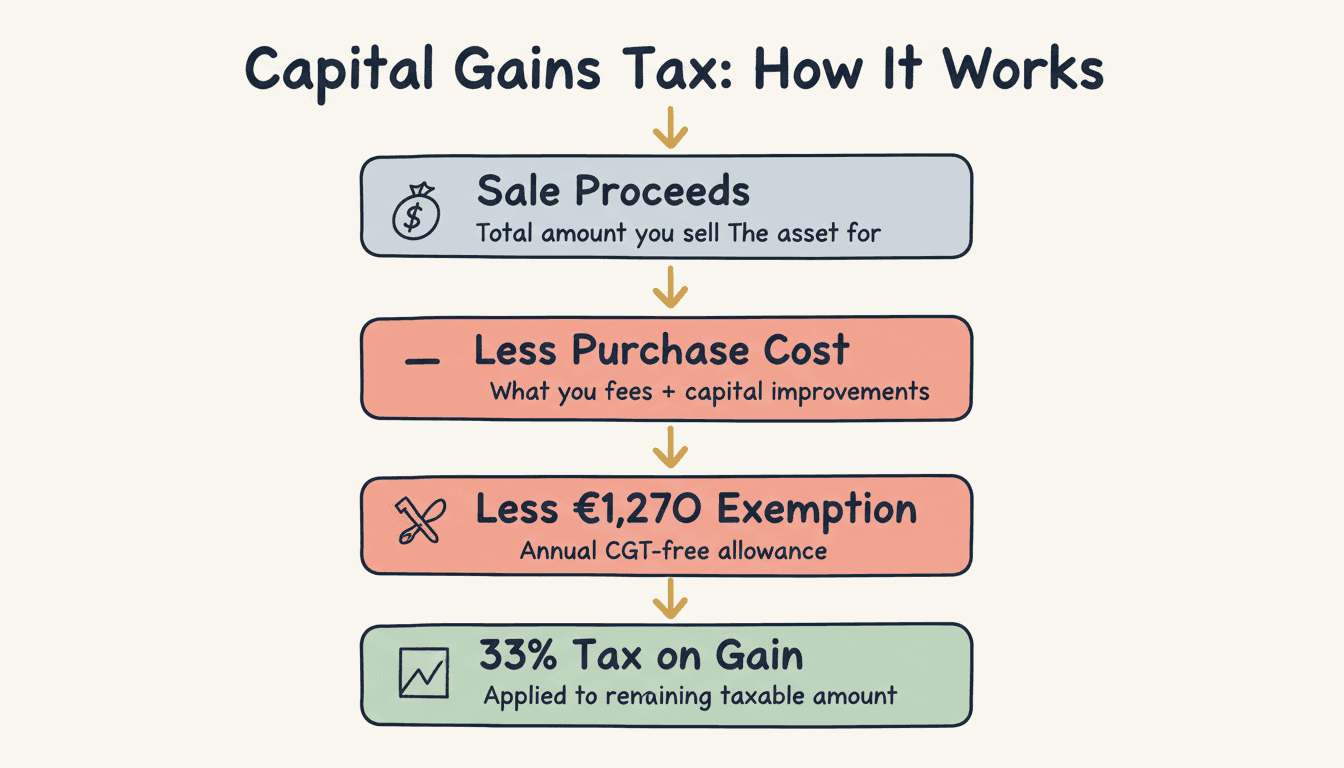
How to Calculate Your CGT
Step 1: Determine the sale proceeds Use the actual sale price (or market value if gifted/swapped).
Step 2: Deduct the cost of acquisition This is what you paid for the asset. For shares, include any stockbroker commission. For property, include legal fees and stamp duty paid at purchase.
Step 3: Deduct enhancement expenditure Any capital spending that improved the asset (e.g., an extension on an investment property) can be deducted. Ongoing maintenance and repairs cannot.
Step 4: Apply the annual exemption Deduct the €1,270 annual exemption from the net gain.
Step 5: Apply the 33% rate The remaining taxable gain × 33% = CGT payable.
Worked Example: Emer sells shares in 2025
| Amount | |
|---|---|
| Sale proceeds | €28,000 |
| Original purchase cost (2018) | –€12,000 |
| Stockbroker commission (buy + sell) | –€400 |
| Net gain | €15,600 |
| Annual CGT exemption | –€1,270 |
| Taxable gain | €14,330 |
| CGT at 33% | €4,729 |
Losses Can Offset Gains
If you made a loss on one asset in the same year, you can offset it against gains on other assets. Net losses in a year can also be carried forward indefinitely to offset gains in future years — but they cannot be offset against income (only capital gains).
This makes loss-harvesting a useful planning tool: if you hold assets that have fallen in value and you're sitting on a significant gain elsewhere, selling the loss-making asset in the same tax year can reduce your overall CGT bill.
Filing and Paying CGT
CGT is filed as part of your income tax return. For self-assessed individuals, it's included on the Form 11. For PAYE workers with capital gains, it's declared on a Form CG1 or through myAccount.
The key deadlines are:
| Period of Disposal | CGT Payment Deadline |
|---|---|
| January to November | 15 December in the same year |
| December only | 31 January of the following year |
Note: payment must be made by these dates even if you haven't yet filed your return. Late payment attracts interest at 0.0219% per day.
Revenue's CGT section has the full filing guidance.
CGT on Cryptocurrency
Cryptocurrency is treated as a chargeable asset for CGT purposes. Every time you:
- Sell crypto for euros
- Swap one cryptocurrency for another
- Use crypto to buy goods or services
...you have a disposal event and potentially a CGT liability. The gain is the difference between the market value at disposal and the cost at acquisition (including any exchange fees).
Revenue does not have a special crypto tax regime — the standard 33% CGT applies. With the EU's DAC8 directive requiring crypto platforms to report user transactions to Revenue, undeclared crypto gains are increasingly likely to be detected.
Frequently Asked Questions
Do I pay CGT when I sell ETFs or investment funds? It depends on the type of fund. For ETFs structured as Irish-domiciled funds (common if purchased through Irish brokers), the gain may be subject to exit tax at 41% in 2025 rather than CGT at 33%. Exit tax applies to "offshore funds" and Irish-domiciled investment undertakings. (2026 update: Budget 2026 cut the fund exit tax rate from 41% to 38% from 1 January 2026.) This is a complex area — check the fund documentation or consult a tax advisor.
I inherited property. What is my cost base for CGT? If you inherited an asset, your CGT cost base is the market value on the date of death of the person who left it to you. Any subsequent gain above this value is subject to CGT when you sell. The inheritance itself is subject to Capital Acquisitions Tax (CAT) at the date of death, but the two taxes are calculated on different events.
Can I transfer assets to my spouse CGT-free? Yes. Transfers between spouses or civil partners are generally CGT-exempt at the time of transfer. However, the receiving spouse "steps into the shoes" of the original owner for cost base purposes — meaning when they eventually sell, CGT will be calculated from the original acquisition cost, not the transfer date.
I'm leaving Ireland and taking my assets with me. Is there a CGT charge? Yes. Departing Ireland is treated as a deemed disposal of certain assets — particularly shares in companies where the value is derived from Irish land. Revenue taxes any gains as if you had sold at market value on departure day. This is known as exit CGT. Take advice before relocating.
What records do I need to keep for CGT purposes? Keep records of the original purchase date, purchase price, any enhancement expenditure, and the sale proceeds for every capital asset. Revenue may request evidence up to six years after disposal. Digital records (brokerage statements, property contracts) are fully acceptable.
This article is for informational and estimation purposes only. It does not constitute professional tax advice. Tax rules can change. Always check Revenue.ie for the latest figures or consult a qualified tax advisor for your specific situation.
Written by a Chartered Accountant
All guides on Irish Tax Estimator are written and reviewed by a qualified Irish Chartered Accountant to ensure accuracy. This article is for general information only and does not constitute professional tax advice.
Share this guide